
Reporte de SOSTENIBILIDAD GRUPO PLASTILENE
What is happening with sustainability in our industry? Are we stagnant? Are we moving forward or back?
In 2017 we structured our Sustainability Innovation Strategy around four fundamentals:
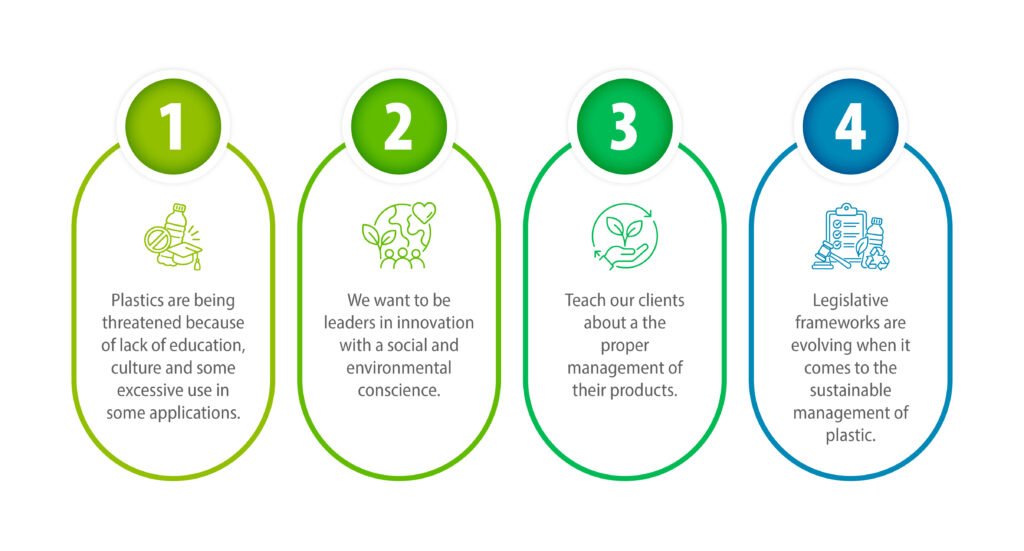
Today, after nine years of work and many changes, we find that these fundamentals continue being 100% true. I ask myself: has nothing changed in nine years? or what is the reason for there not to be any significant changes in the framework of sustainability in our industry?
During these nine years there have been great political and economic changes in humanity such as the wars that unfolded in Europe and the Middle East, the stagnation of the European economy, Brexit in England, and the constant advancement of China as an economic and technological global power. In the Americas, we saw the beginning of a regime change in Venezuela, the first leftist government in Colombia, the continuation of progressive governments in Mexico, and the internal administration change in the United States, situations that have shifted the regional geopolitical sphere with great challenges and uncertainties. On a technological level we saw the beginning of Artificial Intelligence, the boom of electric cars, industrial automatization, the speedy growth of electronic commerce (e-commerce) and an urgency to make our packaging meet increasingly complex logistical requirements.
Uncertainty in the supply chain and the volatility of energy costs and raw materials have reconfigured global supply chains (nearshoring). The search for new materials has taken us to the exploration of alternative materials such as paper, to be used on applications with high specifications, that historically have been dominated by flexible plastic.
Why with so many changes in the world are there no conceptual changes in the packaging industry? Because the properties of polymers and health and safety requirements are a constant: the need to guarantee barrier and food protection, avoid food waste in the logistical supply chain and recover materials do not change with new political or technological changes.
During this period we have made decisive improvements: we consolidated monomateriality as one of our key lines; we promoted recycling processes to achieve PCR certified resins in Reciclene (we went from producing zero kilos of PCR in 2018 to producing 3.261.680 kilos of PCR in 2025); we increased the use of recycled plastic in new packaging (we went from using 3.136.000 kilos in 2018 to 4.967.750 kilos in 2025), and integrated digital traceability to report EPR frameworks and environmental authorities for the transformation of postconsumer plastic. All of this proves that flexible plastic remains technically necessary for food security and to maintain a low carbon footprint when compared to rigid alternatives or other materials.
Even when international diplomacy attempted to create a roadmap through the UN’s Global Plastics Treaty – a process that, although it did not achieve clarity or the expected consensus, reaffirmed the existing global rules –, we confirmed with certainty: international treaties show the roadmap, but real solutions are not signed on desks, they are applied at production plants and throughout the value chain.
That’s why these fundamentals do not change: because modifying the essence of sustainability is not a matter of discourse, but a cultural, organizational, and state wide transformation that requires infrastructure and time.
There are things to do, to work on, we have to be innovative, and move transformation forward together. At Grupo Plastilene we must continue protecting packaging’s contents, we must continue being efficient and economically viable, we must continue being functional and capable of managing an integral and active circular economy, with the participation of all the stakeholders.
The greatest challenge – which has always been there, but today demands real scalability – is the management of postconsumer waste at homes and end users. We are not expectators: we take on a direct commitment of leading relationship building between brands, collection systems, and material innovation, ensuring the effort is not solely on the packaging design, but in recovering and incorporating 30% yearly plastic tonnes.
Looking onward, our 4 initial fundamentals will not change since they make up a structural compass of our raison d’etre. What will change drastically in the next few years is speed, technical scalability, and how we integrate them into every step of our process. It’s not about writing down a deadline, but accelerating the speed in which we can achieve it together.
¡Escríbenos!


